
May 18, 2026 | China Energy News, Page 01
By Su Nan, Wang Lin
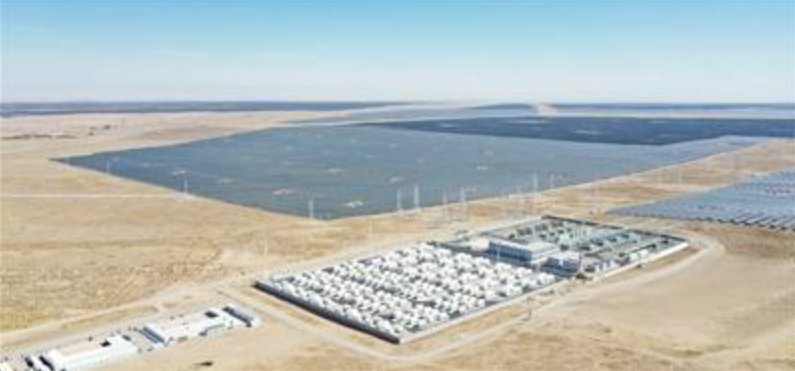
Photo: The Huanghe Fushan Gonghe 200 MW / 800 MWh energy storage project in Hainan Prefecture, Qinghai Province. Photo by Han Wenbin.
Gulu Village clings to the sheer cliff at the entrance to the Dadu River Grand Canyon in Hanyuan County, Ya’an City, Sichuan Province, earning it the moniker “Village on the Heavenly Stairway”. Situated within a forest fire prevention zone, its local power grid must shut down for risk avoidance during extreme weather events. Six 600-kilogram energy storage cabinets then kick into power supply mode. Each cabinet stores 112 kWh of electricity, enabling seamless power switching and continuous power supply for 6 to 8 hours during grid outages. The system resolves Gulu Village’s power access challenges and stands as a vivid demonstration of how energy storage boosts people’s livelihood security.
As a core pillar for constructing a new power system, energy storage represents a critical arena where nations compete to seize commanding heights in energy technology. Over recent years, China’s energy storage industry has achieved a historic leap from following others to running neck-and-neck, and ultimately taking the global lead. Its installed capacity, complete industrial chain and technological prowess rank world-leading, making China the core engine driving global energy storage market growth. The cumulative newly installed capacity of novel energy storage has surpassed 100 GW for the first time, 45 times the figure recorded at the end of the 13th Five-Year Plan period, accounting for over 50% of global installed volume. Under a conservative forecast scenario, cumulative novel energy storage installed capacity will hit 371.2 GW by 2030.
From industrial parks along the southeast coast to large wind-solar bases in the northwest Gobi Desert, from cutting-edge technological breakthroughs in laboratories to empowering global energy transition, the development logic of China’s energy storage sector is shifting from policy-driven single growth to dual growth driven by both policy and market. Its business model is evolving from passive mandatory energy storage matching to active value creation. Supported by robust technological strength and ample growth momentum, the full industrial chain underpins the construction of a powerful energy nation.
A Historic Leap from Follower to Global Leader
China’s energy storage industry acts as the primary growth driver of the global market, boasting the world’s most complete industrial chain. It covers every link spanning the development of key mineral resources such as lithium, sodium and vanadium; production of core materials including cathode/anode materials, electrolyte and separators; battery manufacturing, system integration, and power station operation & maintenance. Leading domestic enterprises dominate global shipment rankings. Fueled by technological iteration, domestic substitution and economies of scale, the cost of energy storage systems has fallen roughly 70% compared with three years ago, drastically improving project economic viability and global competitiveness.
“China’s speed and China’s solutions have become golden calling cards for Chinese energy storage enterprises expanding overseas,” said Chen Haisheng, Chairman of the China Energy Storage Alliance, in an interview with China Energy News. Chinese storage firms deliver remarkable growth momentum compared with European and American counterparts. Their new overseas order volume reached 366 GWh in 2025, a year-on-year increase of 144%, with leading players securing orders covering more than 60 countries and regions worldwide.
Chen Haisheng explained that unlike simple product exports, “China’s solutions” represent an upgrade from product delivery to industrial ecosystem empowerment. On one hand, enterprises leverage full industrial chain advantages to build an integrated overseas expansion model combining cells, system integration and EPC services. On the other hand, industry leaders including CATL, EVE Energy and Sungrow Power have built manufacturing bases in Southeast Asia, North Africa and other regions to pursue deep localised deployment. They have also established international capital platforms via Hong Kong stock listings, exporting technical standards and full-lifecycle services. This transformation marks a landmark shift from “Made in China” to “Intelligently Made in China plus Ecosystem Services”.
The industry is advancing a transition from product export to standard export. Through deeper international cooperation and mutual technical recognition, China strives to integrate its domestic standards into the global energy storage system and contribute Chinese insights to the world. Faced with complex shifts in global geopolitics and trade landscapes, Chinese energy storage enterprises are actively responding to tariff barriers and localised production requirements.
“First, enterprises capitalise on global energy transition opportunities to tap emerging markets and participate in major wind-solar-storage integrated projects by drawing on complete industrial chain strengths,” Chen Haisheng pointed out. “Second, they optimise production capacity layout through overseas factory construction, green power manufacturing and local joint ventures. By participating extensively in large wind-solar-storage integration and microgrid projects, and exporting technical standards alongside full-lifecycle services, they boost market penetration and influence across the globe.”
Liu Yongdong, Deputy Secretary-General of China Electricity Council and Chairman of its Energy Storage Branch, told China Energy News that China’s energy storage standard system has transformed from passive alignment with international norms to proactive standard-setting, lifting the country’s global discourse power substantially. On the international standard front, China participates deeply in the formulation of the IEC 62933 series for electrical energy storage systems. Three international standards for power storage led by Chinese experts were officially released in 2025. “These three standards specify testing methods for operational performance, system design specifications, and environmental impacts of battery failures. They now serve as vital references for global manufacturers, end-users and third-party institutions in product R&D, engineering design and system operation,” Liu added.
Technological Iteration: The Core Driver of Industrial Development
To secure supply chain resilience, China pursues diversified resource security and technological independence. Its energy storage sector has entered an era of parallel multi-technology routes, with diverse technologies delivering scaled breakthroughs across differentiated application scenarios. This landscape is projected to persist throughout the 15th Five-Year Plan period, while long-duration energy storage enters a critical growth phase.
Lithium-ion batteries, the mainstream technology today, are undergoing transformative upgrades. Cell capacity has expanded from 280 Ah to current large-format cells of 500 Ah+ / 600 Ah+. This technological iteration targets cost reduction, efficiency gains and scenario adaptability. Larger-capacity cells lift volumetric energy density from approximately 380 Wh/L to over 415 Wh/L, extend cycle life from around 6,000 cycles to 10,000–15,000 cycles, and support a full service life of 20 years.
“For cost and efficiency optimisation, higher-capacity cells lower unit energy costs by amortising fixed manufacturing expenses over larger energy volumes, while reducing complexity in system wiring and management,” Chen Haisheng explained. “For scenario adaptation, large-format cells boost the energy density of containerised storage systems, saving land and station resources, and meeting demand for longer discharge durations and higher utilisation rates under capacity tariff mechanisms.”
At Fuxin Wind Farm in Liaoning Province, wind turbines rotate at high speed, supported by a 4,500 kWh energy storage battery system that smooths wind power fluctuations. The setup enhances flexibility and operational reliability of the regional power grid, supporting the construction of Fuxin’s 10 GW new energy base. “The wind farm operates far more steadily after the energy storage station went online,” said An Chunlong, the farm’s director.
The Jiangbei Energy Storage Station in Nanjing houses 88 white battery enclosures with a total storage capacity of 193,600 kWh. “This equals one hour of power output from a medium-sized thermal power plant, enough to supply daily electricity for 26,000 households simultaneously,” said Shi Shengdong, Deputy General Manager of Yuanneng Power Transmission & Transformation Branch under State Grid Nanjing Power Supply Company.
These real-world applications exemplify the mature commercialisation of lithium-ion energy storage technology.
Driven by urgent demand for new energy consumption via long-duration storage, breakthroughs have been achieved in flow batteries, compressed air energy storage, molten salt thermal storage and other technologies. Flow batteries and compressed air energy storage are entering the early stage of large-scale commercialisation, respectively resolving bottlenecks such as reliance on imported core materials and geographical deployment constraints.
Ji Lü, General Manager of Zhongchu Guoneng, told China Energy News that China has achieved end-to-end independent intellectual property rights covering system design through core equipment manufacturing for compressed air energy storage, with 100% domestic production of key hardware. “As more industry players launch projects, compressed air energy storage has won widespread industry recognition and stands at a critical inflection point from technical maturity to scaled deployment. The entire industry must unite to jointly improve performance and cut costs, fostering a thriving industrial ecosystem.”
As a vital complement to lithium-ion batteries, sodium-ion batteries have entered the early industrialisation phase, with small-scale mass production and demonstration deployments underway. Key progress has been made in core materials, cell performance and production line matching, paving the path for wider market adoption. Chinese enterprises have achieved full domestic supply of critical materials including cathode materials, hard carbon anodes, electrolyte and separators. Sodium-ion batteries retain high capacity retention at -20°C, and some chemistries maintain discharge capability even at -40°C. They deliver prominent cost advantages at scale, effectively addressing energy storage challenges in frigid regions.
R&D into cutting-edge solid-state battery technology is accelerating rapidly.
Chen Haisheng noted that solid-state batteries feature superior safety and higher energy density, making them suitable for high-end use cases such as backup power for data centres. Semi-solid batteries are already deployed in demonstration projects, while mass commercial production of all-solid-state batteries is expected to launch around 2030.
The essence of technological innovation lies in pushing performance boundaries, and battery technology is no exception.
Research teams from Nankai University and the Shanghai Institute of Space Power-Sources recently solved the challenge of poorly soluble lithium fluoride salts by synthesising a novel fluorinated hydrocarbon solvent molecule. Zhao Qing, Research Fellow at Nankai University’s College of Chemistry, explained that this technology drastically reduces electrolyte consumption while boosting battery power density, promising to double the driving range of existing lithium batteries with identical volume and weight.
Safety represents the lifeline of energy storage. Liu Yongdong stated that China has built an original full-chain technical system covering intrinsic cell safety through system-level risk prevention, with three core breakthroughs:
- Intrinsic cell safety: A three-dimensional defence framework composed of safe electrolyte, non-propagating anodes and heat-resistant separators raises the baseline for thermal runaway risks at the heat source, complying with the national standard GB/T 36276 to reinforce foundational safety.
- System-level early warning & fire control: Integrated “full-domain intelligent early warning – temperature regulation – fire protection linkage” technology paired with full-lifecycle AI prediction algorithms enable precise monitoring and advance identification of risks from individual cells up to station level.
- Multi-tier active suppression: Hierarchical prevention solutions are deployed across cells, modules, clusters and containers, forming an integrated safety protection chain featuring active flame resistance, long-lasting fire retardancy, graded smoke control, rapid pressure relief and intelligent fire suppression. This design ensures no fire ignition within containers and zero flame spread across the entire station.
Reshaping Energy Production and Consumption Models
With accelerated construction of the new power system, energy storage will shift from rapid expansion to steady, long-term development. Aligned with carbon neutrality targets, installed energy storage capacity will reach 10%–15% of total new energy capacity, fundamentally reshaping China’s energy production and consumption patterns. The end result will be a new integrated energy system characterised by clean power generation, electrified end-use consumption and full-chain intelligence.
“On the generation side, scaled energy storage deployment resolves the intermittency and volatility of wind and solar power, driving a shift toward a hybrid distributed-centralised power production model,” Chen Haisheng analysed. “On the consumption side, power use becomes smarter and interactive. User-side energy storage, virtual power plants (VPPs) and vehicle-to-grid (V2G) models gain widespread adoption, transforming industrial and residential consumers into prosumers who both generate and consume power. Meanwhile, energy storage facilitates deep penetration of green power in key sectors including industry, transportation and construction, advancing integrated electrification and decarbonisation of end-use energy.”
Liu Yongdong added that on the generation side, deep coupling between energy storage and wind-solar power enables large-scale, high-ratio grid integration of renewable energy, accelerating the transition to clean, low-carbon power production. On the consumption side, widespread distributed and residential energy storage shifts energy consumption from centralised intake to local distributed absorption. Combined with microgrids and VPPs, these systems support self-sufficient on-site energy supply and real-time supply-demand interaction, building a coordinated new energy consumption framework integrating sources, grids, loads and storage (Source-Grid-Load-Storage).
The energy storage industry currently faces challenges of overcapacity and cutthroat low-price competition. To avoid bad players driving out high-quality enterprises, both government and market mechanisms are working in tandem to eliminate vicious industry competition. On the policy side, authorities are refining electricity market trading rules and launching special funds for technological innovation to guide enterprises to prioritise technical value. Procuring organisations are abandoning price-only tender evaluation criteria, instead incorporating core technical parameters and full-lifecycle reliability as core assessment metrics, pushing enterprises to focus on technological upgrading from the root.
Industry experts interviewed unanimously agreed that as top-level industrial policies mature, China’s energy storage sector is accelerating market-oriented transformation. The Special Action Plan for Large-Scale Novel Energy Storage Development (2025–2027), issued in 2025, has cleared transaction channels for energy storage to participate in energy and ancillary service markets. This year, China introduced a dedicated capacity tariff mechanism for grid-side independent energy storage for the first time, resolving institutional barriers that previously hindered profitability. Further supportive policies covering electricity tariff reform, R&D incentives for storage technologies and demonstration project rollout will be released in the future, driving sustained high-quality development of the energy storage industry and supporting the construction of a powerful energy nation.